To provide legal certainty in determining tax residency (Domestic Tax Subject/Subjek Pajak Dalam Negeri (“SPDN”) and Foreign Tax Subject/Subjek Pajak Luar Negeri (“SPLN”)), the Directorate General of Taxes (“DGT”) issued DGT Regulation No. PER-23/PJ/2025 (“PER-23”) on 9 December 2025.
In general, the matters regulated under PER-23 have substantially been addressed in Minister of Finance Regulation No. 18/PMK.03/2021 as the implementing regulation of the Job Creation Law. In addition, PER-23 revokes PER-02/PJ/2009 and PER-43/PJ/2011, thereby reducing the legal uncertainty arising from those regulations.
PER-23 reaffirms that tax subjects include individuals, entities, undistributed inheritance treated as a single entity, and clarifies how they are determined as either domestic tax subjects or foreign tax subjects.
PER-23 primarily:
- consolidates and clarifies the rules for determining individuals as domestic tax subjects;
- refines the concept of domestic corporate tax subject status, including the management and control center; and
- provides a clearer and more systematic framework for Indonesian citizens (WNI) residing abroad to be treated as foreign tax subjects.
Below are the key criteria to determine whether an individual or entity is categorized as SPDN or SPLN.
1. DOMESTICINDIVIDUAL TAX SUBJECT
An individual (Indonesian citizens (WNI) or foreign citizens (WNA)) is classified as SPDN if any of the following criteria is satisfied.
A.Residing in Indonesia
“Residing” is assessed based on actual circumstances, including whether the individual:
- has a place in Indonesia that is controlled/available at any time, owned/ leased/available for use, and not merely a stopover,
- has a main center of activities in Indonesia (personal, social, economic, and/or
financial), - carries out daily habits/activities in Indonesia (including hobbies).
B. Presence in Indonesia for more than 183 days within any 12-month period
The 183-day test is measured based on the individual’s presence in Indonesia within a 12- month period (either continuously or occasionally). Part of a day counts as one full day.
C. Presence in a fiscal year with an intention to reside in Indonesia
“Intention to reside” may be shown by having documents such as:
- a Permanent Stay Permit Card (Kartu Izin Tinggal Tetap/KITAP),
- a Limited Stay Visa (Visa Tinggal Terbatas/VITAS) or a Limited Stay Permit (Izin Tinggal Terbatas/ITAS) which valid for more than 183 days,
- a work/business/activity contract exceeding 183 days,
- other documents (e.g., a residential lease for more than 183 days or evidence of immediate family relocation).
PER-23 further elaborates/clarifies that ‘being present’ refers to physical presence in Indonesia (including short visits such as airport transit) and excludes virtual presence (e.g., online meetings for remote oversight).
2. DOMESTICCORPORATE TAX SUBJECT
A corporate taxpayer is treated as a domestic tax subject if it is established in Indonesia or domiciled in Indonesia.
A. Established in Indonesia
An entity (excluding a PE) is considered “established in Indonesia” if its formation is based on Indonesian law, registered in Indonesia, or within Indonesia’s jurisdiction
B. Domiciled in Indonesia (including “management and control”)
An entity is domiciled in Indonesia if it has:
- a registered office in Indonesia based on its deed of establishment;
- a head office/administrative center/financial center in Indonesia; or
- a management and control center in Indonesia.
PER-23 emphasizes that an entity has its management and control center or place of effective management in Indonesia if strategic policies and/or decisions regarding investment and/or operational activities are made in Indonesia.
Illustrative strategic decisions include, among others: decisions on share/asset transfers, transfer or utilization of strategic assets, appointment/termination of key management or authorized agents, and supervision/control over dividend distribution.
PER-23’s appendix illustrates that holding a substantial portion of board meetings in Indonesia (e.g., 6 out of 12 meetings, or 50%), together with key strategic decisions being made in Indonesia, may indicate that the entity’s management and control center is in Indonesia.
3. FOREIGN TAX SUBJECT – FOR WNI RESIDING ABROAD
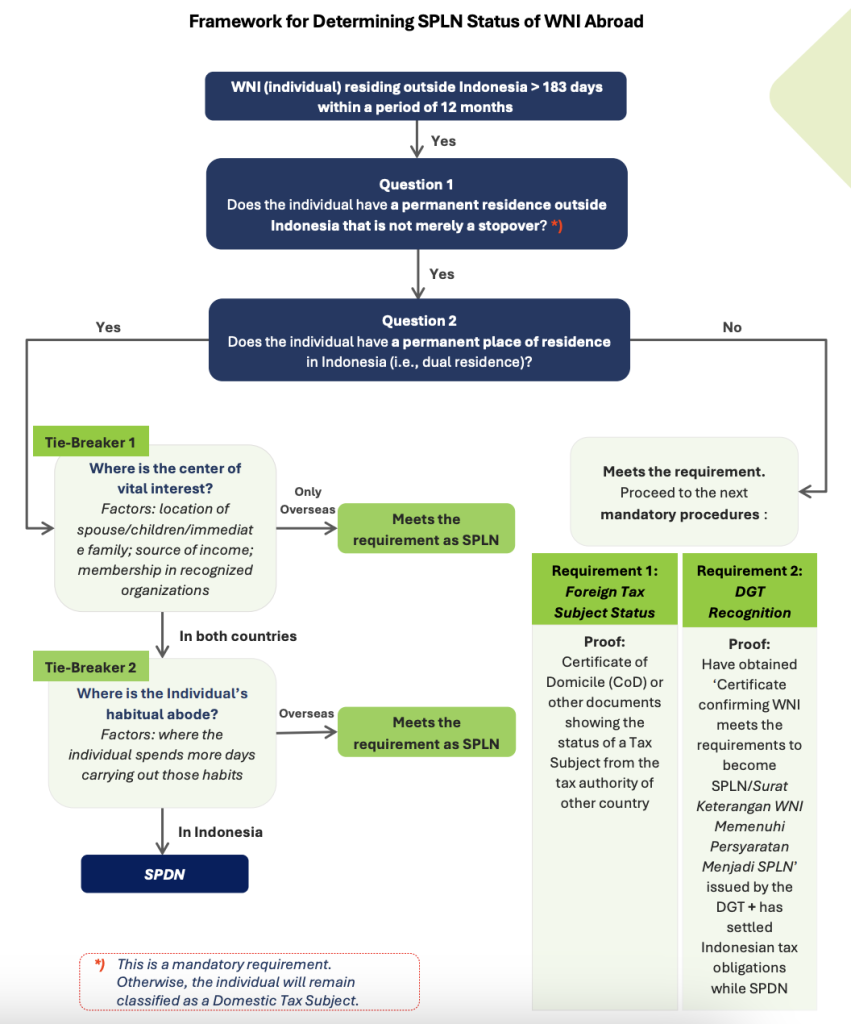
PER-23 sets out a structured approach for determining SPLN status for Indonesian citizens (WNI) who presence outside Indonesia for more than 183 days within a 12-month period, subject to fulfilling specific requirements.
A. Key requirements (“sequential” assessment)
In order to determine how WNI residing abroad are classified as SPLN, please refer to the diagram on the next page:
B. Tie-breaker concepts and “immediate family”
If an individual or entity is an Indonesian tax resident under PER-23 and is also regarded as a tax resident of a treaty partner jurisdiction, the residency status is determined based on the relevant tax treaty (P3B) provisions. Where relevant, PER-23 uses tie-breaker concepts (e.g., center of vital interests and habitual abode). PER-23 defines “immediate family” for
these purposes as family members related by blood or marriage in a direct line and/or within one degree of collateral relationship.
C. Certificate of Domicile (“CoD”) issued by another country or jurisdiction – minimum content and timing constraint
To evidence tax residency in another jurisdiction, the CoD or an equivalent document must be issued in English and at minimum include the WNI’s name, the issuance date, the validity period, and the name/signature (or equivalent) of an authorized official.
PER-23 requires the SPLN application to be filed no later than six months from the CoD expiry date. If the CoD does not specify an expiry/validity period, the issuance/signing date is treated as the beginning of the period.
D. Certificate issued by the DGT confirming WNI meets the requirements to become SPLN
Procedurally, the process to obtain the Certificate confirming WNI meets the requirements to become SPLN is regulated by Minister of Finance regulation number 18/PMK.03/2021.
PER-23 provides several illustrative examples on the determination of domestic and foreign tax subject status for both individuals and corporates, to improve clarity in understanding and practical application.